How Much Does AC Repair Cost in 2026? The Full Price Guide (With Real Numbers)
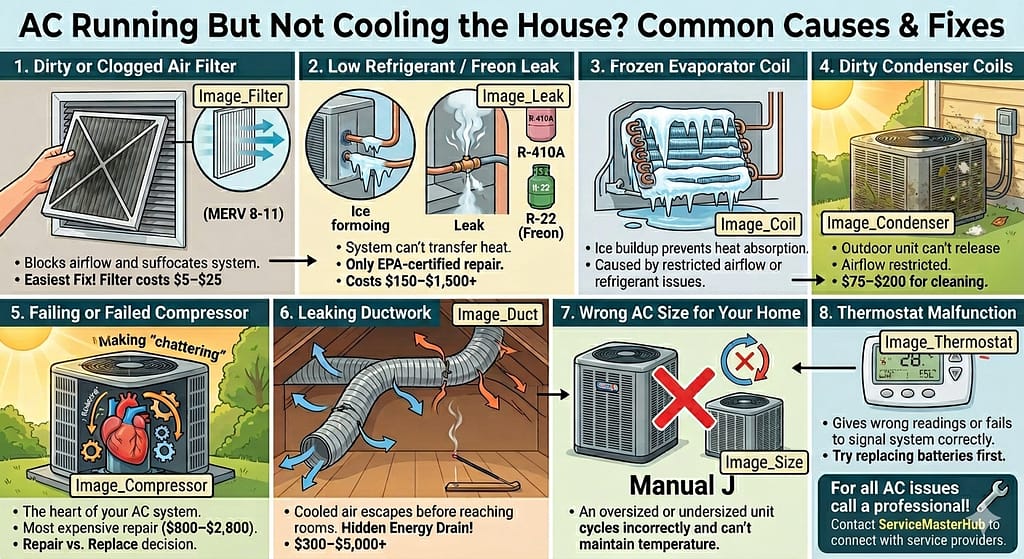
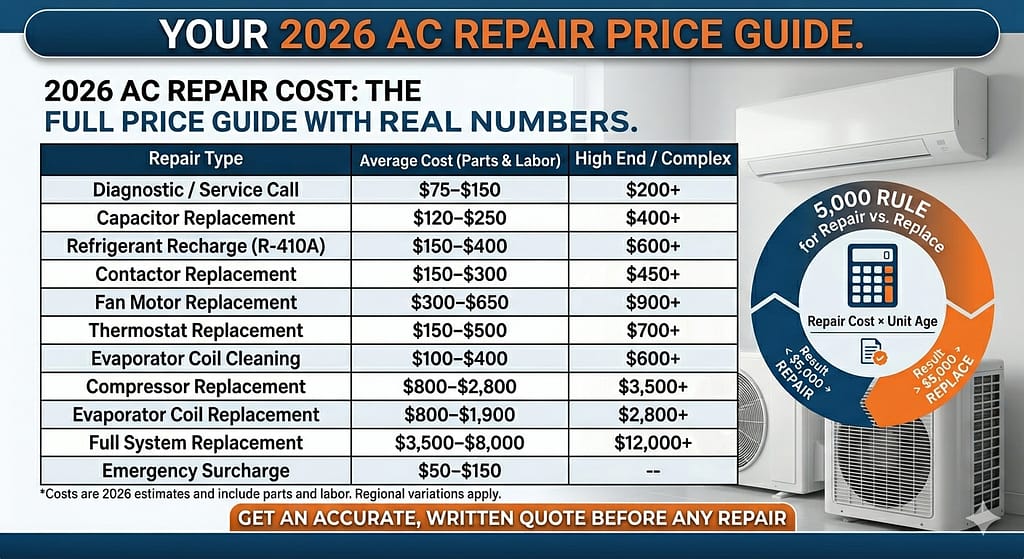
The moment your AC stops working on a 95°F afternoon, you’re vulnerable. You need it fixed, you need it fixed today, and you have no idea what a fair price looks like. That’s exactly the position HVAC companies know you’re in — and some will take advantage of it. This guide is your defense. We’ve compiled real 2026 cost data across every common AC repair type so you walk into any service call knowing what fair looks like, what red flags sound like, and when a repair isn’t worth doing at all. Bottom line upfront: The average AC repair cost in 2026 ranges from $85 to $650 for common repairs. Emergency service adds $50–$150 to any job. A full compressor replacement can run $800–$2,800. Here’s what you should actually expect to pay — broken down by repair type. Quick Reference: AC Repair Cost by Type (2026) Repair Type Average Cost High End Service/diagnostic call $75–$150 $200 Air filter replacement (by tech) $20–$60 $100 Refrigerant recharge (R-410A) $150–$400 $600 Refrigerant recharge (R-22) $400–$900 $1,500+ Capacitor replacement $120–$250 $400 Contactor replacement $150–$300 $450 Fan motor replacement $300–$650 $900 Evaporator coil cleaning $100–$400 $600 Condenser coil cleaning $75–$200 $350 Thermostat replacement $150–$500 $700 Evaporator coil replacement $800–$1,900 $2,800 Compressor replacement $800–$2,800 $3,500 Ductwork repair/sealing $300–$1,000 $3,000+ Full AC system replacement $3,500–$8,000 $12,000+ Costs include parts and labor. Regional variation applies. AC Repair Cost Breakdown by Repair Type 1. Refrigerant Recharge: $150–$400 (R-410A) What it is: Refrigerant is the chemical compound that absorbs heat from your home’s air and releases it outside. When refrigerant levels are low (always due to a leak), cooling capacity drops significantly. Why it fails: Refrigerant doesn’t deplete naturally. Low levels always indicate a leak in the system — at the coil, the lines, or fittings. A responsible technician will always locate and repair the leak before recharging. Cost breakdown: R-22 (Freon) caveat: If your system was installed before 2010, it likely uses R-22, which was phased out of production in 2020. Remaining supply is expensive. A single-pound R-22 recharge can cost $100–$200 per pound. If you’re paying $400+ just for refrigerant on an older system, a full replacement conversation is warranted. DIY possibility: None. EPA regulations prohibit unlicensed individuals from purchasing or handling regulated refrigerants. Repair vs. replace threshold: If a refrigerant leak requires evaporator or condenser coil replacement and your unit is 10+ years old, replacement often makes more financial sense. 2. Capacitor Replacement: $120–$250 What it is: The capacitor is an electrical component that stores and releases energy to start and run the AC’s motors (the compressor and fan motors). Without a functioning capacitor, the motors can’t start or run efficiently. Why it fails: Heat is the primary enemy of capacitors. Units in hot climates fail more frequently. The average capacitor lifespan is 10–20 years, but in high-heat environments, failure at 5–10 years is common. Cost breakdown: DIY possibility: Technically possible, but capacitors store a lethal electrical charge even when the unit is unplugged. This is a job for a licensed technician. The part is inexpensive; the labor reflects the expertise and safety required. Red flag: Any company charging more than $350 for a capacitor replacement on a standard residential unit is likely overcharging. 3. Contactor Replacement: $150–$300 What it is: The contactor is an electrical relay that switches power to the compressor and condenser fan motor when the thermostat calls for cooling. A failing contactor can cause the AC to not start, short cycle, or run continuously. Why it fails: The contactor’s electrical contacts pit and burn over time from repeated electrical arcing. Pest damage (insects are attracted to the warmth and sometimes get inside the contactor) also causes premature failure. Signs of a bad contactor: AC doesn’t start at all, you hear a clicking sound but the unit doesn’t run, or the system runs continuously without shutting off. DIY possibility: Low. The contactor sits near high-voltage components. Professional replacement is strongly recommended. 4. Fan Motor Replacement: $300–$650 What it is: Your AC system has two fan motors — the blower motor (moves air over the indoor evaporator coil) and the condenser fan motor (exhausts heat from the outdoor unit). Either can fail independently. Why it fails: Worn bearings, overheating, age, and lack of lubrication are the primary causes. Condenser fan motors are particularly prone to failure because they operate in harsh outdoor conditions. Signs of a failing fan motor: Cost breakdown: 5. Evaporator Coil Replacement: $800–$1,900 What it is: The evaporator coil is the indoor component over which warm air passes to be cooled. It’s where refrigerant absorbs heat from your home’s air. Why it fails: Corrosion is the leading cause — particularly from formaldehyde off-gassing from certain building materials and from acidic condensate water. A cracked or corroded coil leaks refrigerant and loses efficiency. This is one of the repair-vs-replace decision points: An evaporator coil replacement on a 10+ year-old system is a significant investment in aging equipment. Get a full system quote alongside the repair quote. 6. Compressor Replacement: $800–$2,800 What it is: The compressor is the most critical component in your AC system. It circulates refrigerant and creates the pressure differentials that make cooling possible. A failed compressor means total loss of cooling. Why it fails: Low refrigerant (the compressor overheats without adequate refrigerant), electrical failures, age, and overheating from poor maintenance. The warranty question: Most compressors carry a 5–10 year manufacturer warranty. Check your original installation paperwork or the model number on the unit before authorizing an out-of-warranty replacement. Many homeowners have paid for a compressor replacement that should have been covered. When to replace the whole system instead: If your compressor fails and your unit is more than 10 years old, replacement of the full system is often the financially superior choice. You’re paying $800–$2,800 to repair an aging system that still has aging coils, aging electrical components, and older refrigerant technology. 7. Thermostat Replacement: $150–$500 What it is: The thermostat reads your home’s temperature and signals the AC