
10 Signs Your Air Conditioner Needs to Be Replaced in 2026
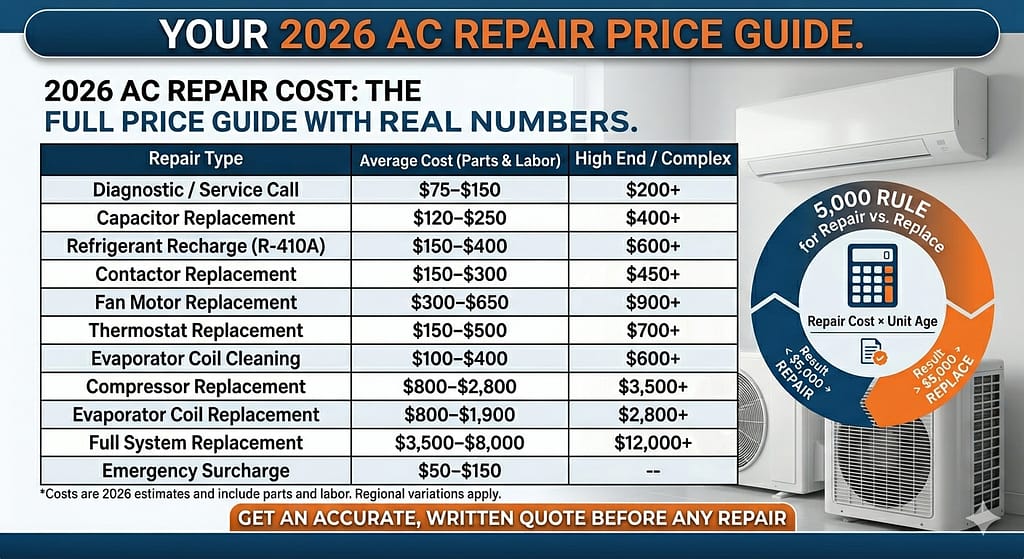
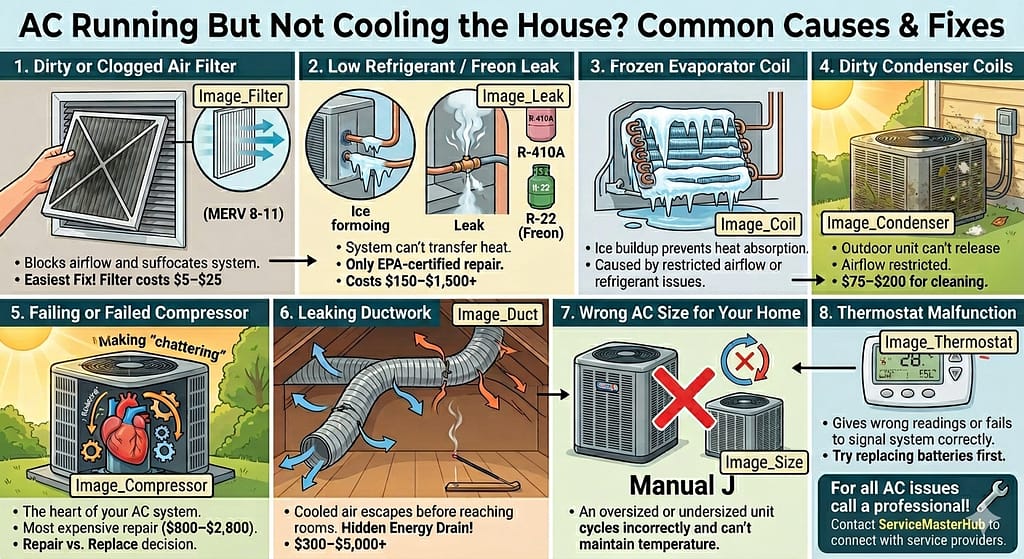
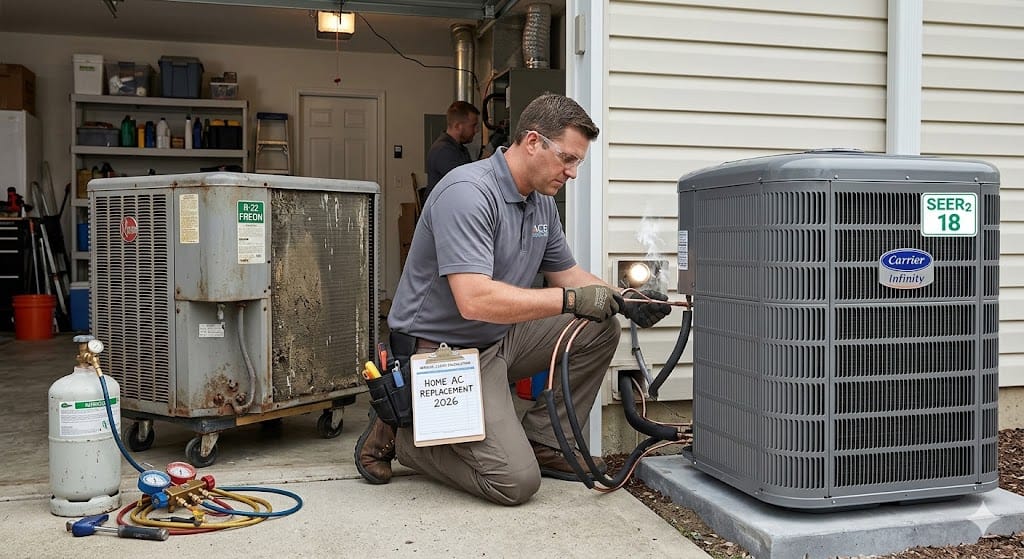
Replacing your air conditioner is a $3,000–$8,000 decision. That’s not a purchase you make on a gut feeling or because a technician tells you it’s time. You make it when the evidence is clear — and when the math stops making sense on repairs. But here’s what nobody tells you: most homeowners wait too long. They keep patching a failing system with one repair after another until a single summer costs them more in emergency fixes than a new unit would have. The technicians who service those calls aren’t complaining, but you should be. This guide gives you the honest 10-sign framework HVAC engineers use to evaluate whether an AC system has reached end of life — plus a repair-vs-replace calculator, information on what new AC technology in 2026 actually means for your home, and what to expect from a replacement project. Sign 1: Your System Is 12–15+ Years Old Age alone isn’t a reason to replace your AC, but it’s the context that makes every other sign on this list more serious. The average lifespan of a central air conditioning system is 15–20 years with proper maintenance. Without consistent annual servicing, that range shrinks to 10–12 years. Systems in hot southern climates (Texas, Florida, Arizona) tend to age faster due to longer operating seasons. Here’s what age really means practically: after 12–15 years, you’re not just maintaining an older unit. You’re maintaining older refrigerant technology, older efficiency ratings, older capacitors, older contactors, and older coils — all approaching end of life roughly simultaneously. At that stage, every repair buys you less time than the same repair on a younger system. What to do: Check the manufacturer label on your outdoor unit for the installation date. If it’s 2010 or older, factor age heavily into any repair decision. Sign 2: You’re Scheduling Repairs More Than Once a Year A well-maintained AC system should require one professional service visit per year — a spring tune-up. If you’re calling HVAC companies two, three, or more times in a single year for different repairs, your system is entering a pattern of cascading failure. Think of it like an aging car. A single repair once every few years is normal maintenance. But when you’re at the shop every few months — first the alternator, then the water pump, then the brakes — the economics shift. You’re no longer maintaining a car; you’re funding its dying months. For AC systems, the economics are especially stark because HVAC repairs have a high service call base cost ($75–$150 per visit before parts and labor). If you’ve spent $300, $500, or $700 in multiple repair visits in a single year on a 10+ year-old system, that money is gone and your system is still aging. Rule of thumb: If your annual repair costs exceed $500 on a system older than 10 years, it’s time to get a replacement quote and compare the math. Sign 3: Your System Uses R-22 Refrigerant (Freon) This is one of the most definitive replacement triggers — and millions of homeowners don’t know it applies to them. R-22 (Freon) was the standard refrigerant in residential AC systems installed before approximately 2010. The U.S. Environmental Protection Agency phased out R-22 production and import entirely on January 1, 2020, due to its ozone-depleting properties. The result: R-22 is now an increasingly scarce commodity. What once cost $10–$15 per pound now costs $100–$200 per pound or more, and that price will only rise as existing stockpiles deplete. Practical impact: If your pre-2010 system develops a refrigerant leak — which is increasingly common in aging systems — a repair that would cost $200 on a modern system can cost $1,000–$2,500 on an R-22 system. You cannot simply convert an R-22 system to use modern refrigerants without replacing the entire refrigerant circuit. How to check: Your system’s refrigerant type is printed on the label of the outdoor unit. Look for “R-22” or “HCFC-22.” If you see this, add it to your replacement planning. Sign 4: Your Energy Bills Are Rising — Without a Usage Explanation Air conditioners lose efficiency as they age. Internal components wear, coils develop buildup that insulates heat transfer, ductwork develops leaks, and refrigerant levels can drop slightly. The result is a system that works harder and longer to achieve the same (or worse) cooling results. If your electricity bills have increased 15–25% over the past 2–3 years without a corresponding change in usage patterns, rates, or home size, your AC system’s declining efficiency is a likely contributor. Modern AC systems are dramatically more efficient than those installed even 10 years ago. Older systems often carry SEER (Seasonal Energy Efficiency Ratio) ratings of 8–12. Current minimum standards for most U.S. climate zones in 2026 are 14–15 SEER2, with high-efficiency models reaching 20–26 SEER2. The real-world difference: replacing a SEER 10 system with a SEER2 18 system can reduce your cooling energy costs by 30–50%, depending on climate and usage patterns. Sign 5: Your Home Has Uneven Cooling — Some Rooms Are Always Hot One or two bedrooms are always warmer than the rest of the house. The upstairs never gets as cool as the main floor. These hot spots have been persistent for years, and no amount of thermostat adjustment or vent-redirecting seems to fix it. Uneven cooling can have several causes — ductwork leaks, damper issues, airflow imbalances — but when it occurs in an aging system that’s already showing other signs from this list, it’s often a symptom of a system that has lost the capacity to adequately condition your whole home. This is distinct from a new or previously well-functioning system that suddenly develops uneven cooling, which is more likely to indicate a specific solvable problem (refrigerant leak, dirty coil, etc.). Sign 6: Indoor Air Quality Is Worsening Your AC system does more than cool your home — it filters and dehumidifies the air. As a system ages, several things can happen that degrade air quality: Signs: Increased dust in the home